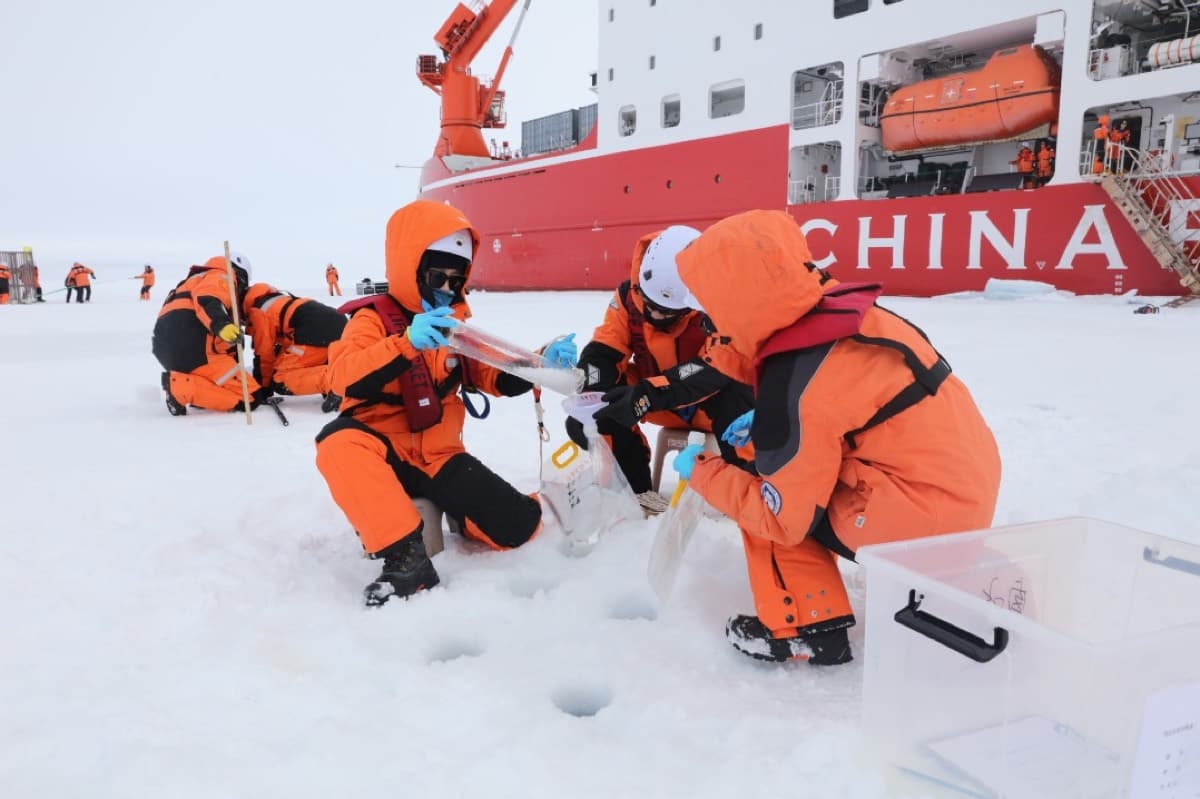
During China's 16th Arctic Ocean scientific expedition, the research vessel Xuelong set a record: over 14 days of operations it established 12 sea-ice observation stations, the most deployed by a single vessel in a Chinese Arctic mission. Work began on July 25, and all the stations lie north of 82 degrees latitude.
An observation array on the ice
The sites were chosen with the durability of the sea ice through the summer melt season in mind. The team deployed more than 30 ice-based buoys across the stations. A leader of the sea-ice team said the hydrology group has more than a dozen ice-based ocean profiling buoys, so they set up 12 ice stations to carry out array monitoring. In addition, Xuelong 2 planned to establish about seven more stations.
For samples, the team extracted a sea-ice core 1.3 meters thick and 1.2 meters on each side to study the physical and mechanical properties of sea ice. The observations focus on several areas, including the atmospheric boundary layer, sea-ice physics, sub-ice ecology and sub-ice ocean dynamics.