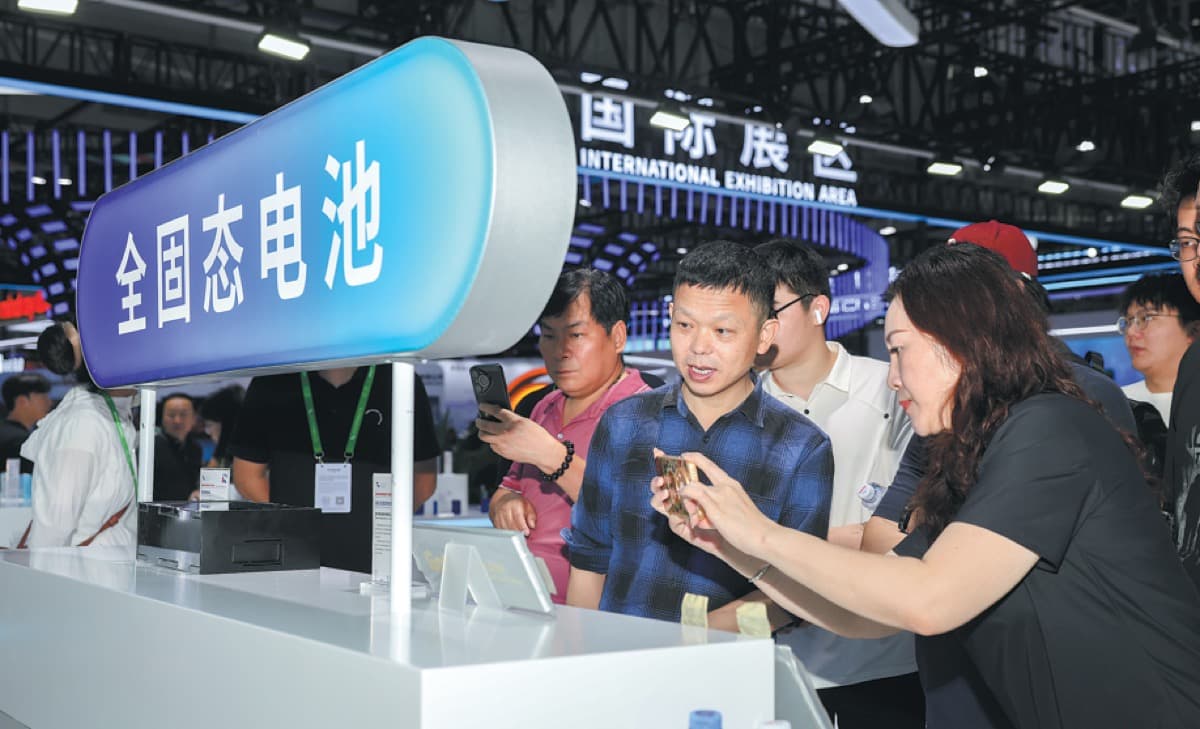
China is racing to position all-solid-state batteries as the next extension of its advantages in the battery sector, aiming to turn the country into a global leader in the field, industry experts said.
A national five-year roadmap
The comments followed a plan jointly released last week by seven government authorities, including the Ministry of Industry and Information Technology, which set 2030 as the target for the initial large-scale deployment of all-solid-state batteries. Under the plan, applications for the technology are also set to expand well beyond cars to include ships, aircraft, intelligent robots, industrial machinery, power grids, industrial parks and data centers.
The plan describes the 2026 to 2030 period as a strategic window for consolidating China's global competitive edge in advanced batteries, while acknowledging weaknesses including insufficient original and disruptive innovation, overcapacity, disorderly competition, and gaps in standards and intellectual property. Nan Cewen, an academician at the Chinese Academy of Sciences and a professor at Tsinghua University, described the plan as marking a shift in the industry's competitive paradigm. He said it was the first time China had systematically mapped out the development of the emerging battery industry at the level of a national five-year plan, signaling a shift in competition away from simply expanding production capacity and toward broader rivalry over product value, corporate competitiveness and the modernization of the industrial chain, adding that the plan takes a full chain approach covering new battery mechanisms, materials, structures and manufacturing processes.
Investment running ahead of commercialization
According to the Gaogong Industrial Research Institute, China announced about 60 new solid-state battery projects in 2025, representing 189 gigawatt-hours of planned capacity and roughly 67.7 billion yuan, or about 10.1 billion US dollars, of investment. In the first half of the year alone, more than 40 solid-state battery and related materials projects were announced, with planned investment exceeding 50 billion yuan.
All-solid-state batteries replace the flammable liquid electrolyte used in conventional lithium-ion cells with solid materials, which in theory can improve both safety and energy density, letting an electric vehicle travel farther on a battery of the same weight.
Where the major battery makers stand
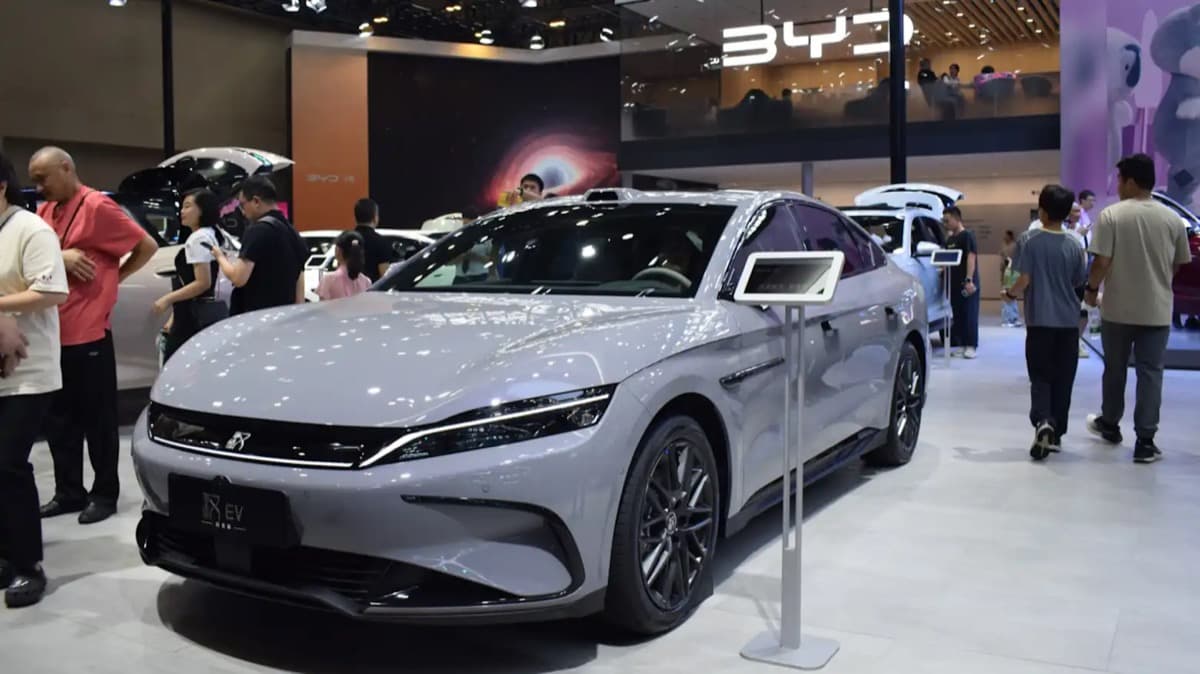
Chinese battery makers are increasingly converging on a similar commercialization timetable. CATL has said it is targeting small-scale production of all-solid-state batteries around 2027, while cautioning that the technology remains several stages away from full maturity. BYD has pointed to 2027 for initial vehicle demonstrations, followed by broader deployment around 2030. Gotion High-Tech has disclosed all-solid-state cells with an energy density of around 400 watt-hours per kilogram and is building a 2 gigawatt-hour production line, while EVE Energy rolled out new solid-state battery cells from its base in Chengdu, Sichuan province, this year as part of its engineering validation program. CALB, another major Chinese battery producer, has been developing higher energy density solid-state batteries aimed at cars, robots and aircraft, alongside dedicated pilot production capacity.
Ouyang Minggao, an academician at the Chinese Academy of Sciences, said test vehicles equipped with all-solid-state batteries could appear as early as late 2026 or 2027, but that large-scale production would most likely still take another three to five years.
Beyond the car
China is explicitly looking past the automotive sector. Its battery plan identifies robots, aviation, shipping, and deep space and deep sea applications as potential markets for advanced batteries, reflecting an expectation that solid-state technology may first gain traction in fields where buyers are willing to pay a premium for higher energy density. After the plan was released, Liu Wenqiang, Party secretary of the China Center for Information Industry Development, said China's scale advantage does not guarantee it will keep its lead over the long run. As Chinese battery makers move closer to the technological frontier, he said, there are fewer mature technologies left to draw on, meaning companies will increasingly need to chart their own technical paths rather than rely on expansion and incremental upgrades.