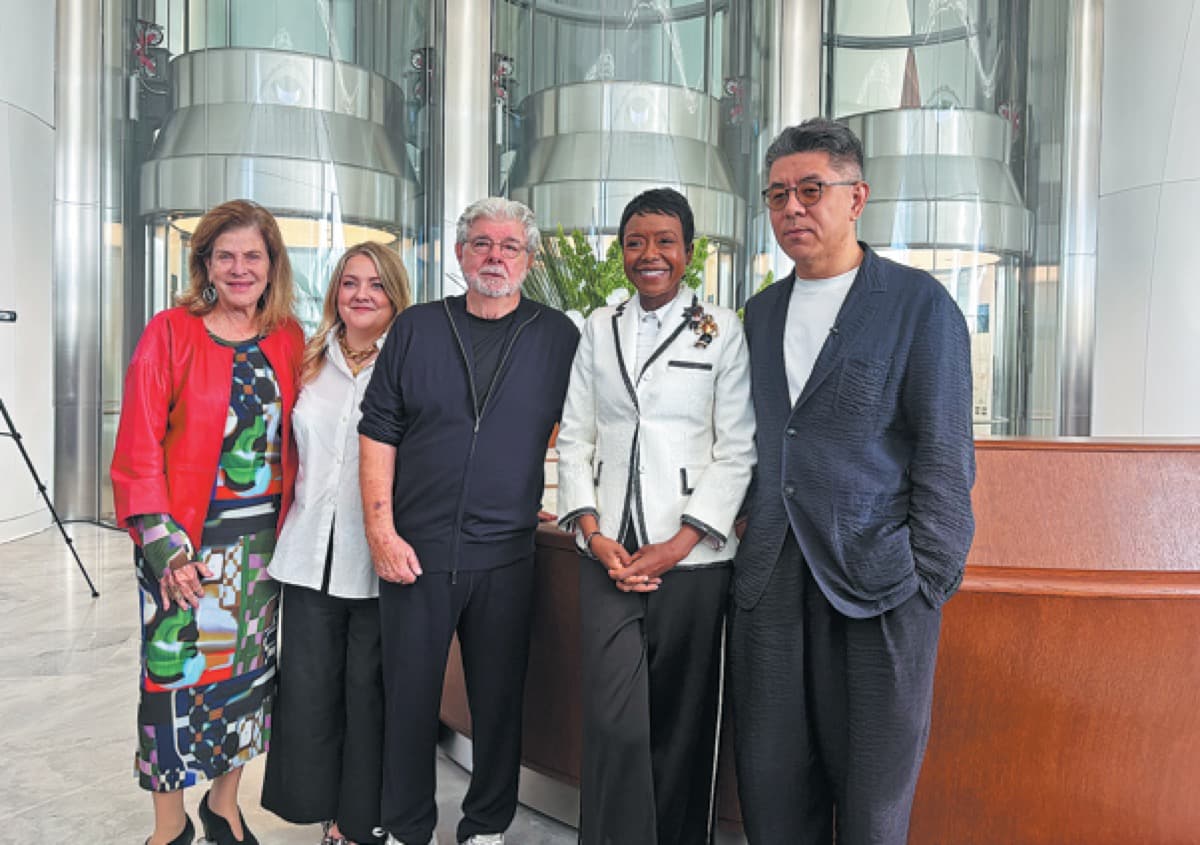
The opening of the Lucas Museum of Narrative Art has added a new cultural landmark to Los Angeles, bringing together film, illustration, comics, murals, architecture and landscape while creating a new space for cross-cultural exchange.
A floating cloud
The museum was founded by filmmaker George Lucas, creator of Star Wars, and his wife, Mellody Hobson, and opened to the public last month with a sold-out first day. It was designed by Chinese architect Ma Yansong, founder of MAD Architects, and the 28,000 square meter building traces visual storytelling across cultures and centuries, from cave paintings to cinema and murals.
For Ma, the project was also a chance to bring ideas rooted in Chinese architectural tradition to a major American cultural institution. He conceived the building as a floating cloud, letting the landscape and public space flow beneath it rather than placing a conventional architectural box in the middle of the park. He said the approach drew on contemporary technology, traditional Chinese gardens and his own childhood in Beijing, where lakes, gardens and buildings exist closely intertwined with one another.
An architectural language that crosses cultures
Ma said that as a Chinese architect he has been deeply influenced by traditional Chinese architecture, particularly its garden traditions, but argued that the building of the future should be something new rather than a simple repeat of wooden structures or sloping roofs, continuing instead to create space and connect to nature and human emotion. He said the idea travels across cultures because the relationship between people and nature is universal, adding that when he brings the concept to the United States or Europe, people respond to it because nature is a topic everyone shares, and that traditional Chinese architecture had already engaged with that emotional and spiritual dimension, going beyond questions of sustainability and the environment. For Ma, the Lucas Museum became a way to show that architectural traditions rooted in China can inform a contemporary global design language rather than simply reproducing historical forms. The museum describes Ma's design as a form of emotional architecture that blurs the boundary between building and park and invites visitors to experience the architecture itself before entering the galleries.