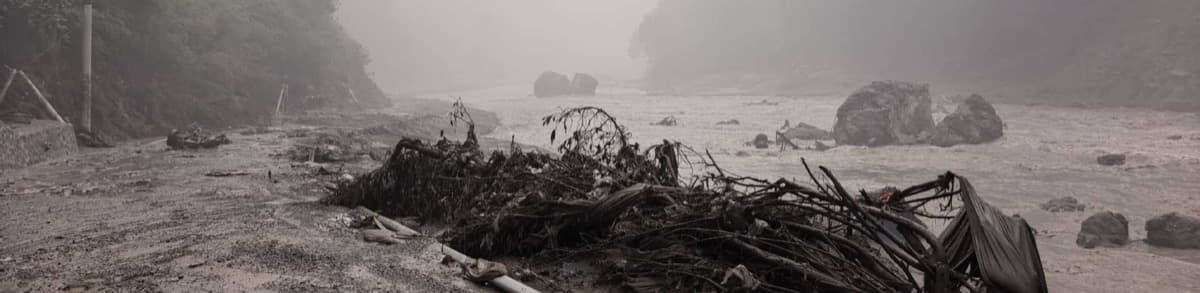
A mudslide has struck the Gyirong border port on the China-Nepal frontier. Around 10:30 am Wednesday, a high altitude glacier collapsed on the Nepalese side of the border, sending a torrent into the port in Gyirong county, Shigatse, in China's Xizang autonomous region, and causing heavy casualties. According to the local disaster command center, as of 8 am Thursday three people had been confirmed dead and 558 remained missing, including 260 identified as foreign nationals, while two villagers had been rescued.
A toll still being verified
On the evening the disaster struck, officials had put the number of missing at 265, a figure that rose to 558 by Thursday morning. The change reflects rescuers working to verify the scale of the disaster under conditions of cut roads, power and communications, rather than a sudden worsening of the disaster itself. More than 300 villagers from communities near the port have been moved to safety in Gyirong county with the help of border inspection rescue forces.
Risk from an upstream barrier lake
China's Ministry of Water Resources said the mudslide left behind a barrier lake near the confluence of the Chhochen Khola and Purepu Tsangpo rivers on the Nepalese side, holding an estimated 2 million cubic meters of water as of Thursday morning and already overflowing, with another 3 million cubic meters expected to flow in over the following three days, putting the risk of a breach at a high level. The ministry said it is closely tracking the lake and running calculations on a possible outburst flood to support emergency response.
An all-out search and relief effort
President Xi Jinping has ordered an all-out effort to search for the missing, evacuate residents in danger and treat the injured. Premier Li Qiang arrived at Gyirong township on Thursday afternoon to oversee the response. China has activated Level-II emergency responses for both natural disaster relief and geological hazards, and national rescue teams, military and civilian medical personnel, and an initial batch of about 30,000 relief items have been arriving in the disaster zone, alongside efforts to restore communication and power infrastructure.