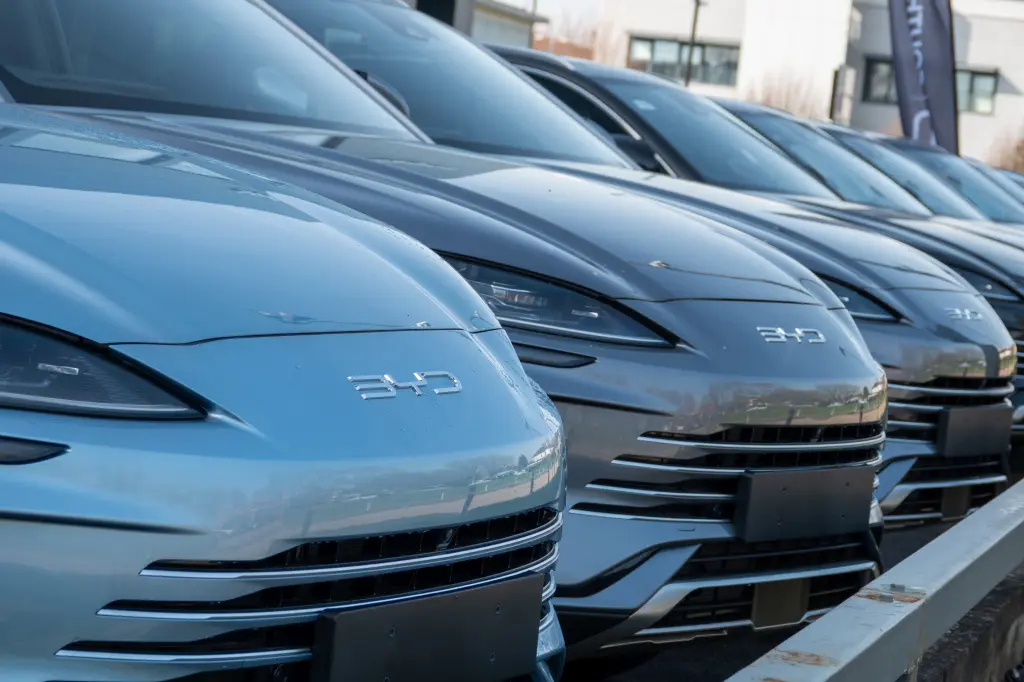
Chinese passenger car exports jumped again in September, even as domestic sales kept sliding, a contrast that has put fresh attention on a car trade arrangement the European Union reached with China last week.
Exports surge as the home market cools
According to data from the China Association of Automobile Manufacturers, passenger car exports rose 64 percent year over year in September to 919,000 vehicles, bringing the total for the first nine months of 2026 to 7.1 million vehicles, up roughly 70 percent from a year earlier. Domestic passenger car sales, meanwhile, fell 27 percent in September to 1.6 million units. Several analysts expect full year exports to approach 10 million vehicles in 2026.
Brussels sets an annual quota for hybrids
EU trade chief Maroš Šefčovič announced Friday that Brussels and Beijing had reached an arrangement covering hybrid vehicles, including plug in hybrids. Starting in December, the EU will cap annual imports at 350,000 hybrid vehicles, with customs authorities across its 27 member states coordinating to track shipments and halt them once the quota is reached. Vehicles that Chinese automakers build inside Europe are excluded from the cap.
A persistent cost edge
Analysts point to a wide cost gap as a key reason Chinese automakers keep gaining ground overseas. A Chinese built electric vehicle costs roughly 20,000 dollars to produce on average, compared with about 31,000 dollars for a comparable European built model, according to Stephen Chan, an analyst at S&P Global Ratings. Xiao Feng, who heads China industrials research at CITIC CLSA, and Ming Lee, who heads Greater China auto research at BofA Global Research, have both pointed to that cost advantage as central to how far Chinese brands can expand abroad.
BYD leads a push into new markets
BYD and other Chinese automakers are expanding more aggressively into Latin America, Southeast Asia and Africa, while building out production capacity in Thailand, Indonesia, Brazil and Hungary. Stella Li, BYD's executive vice president, oversees the company's global expansion. Chinese automakers have also recently reached an arrangement with Canada to lower tariffs on EV exports. The US market remains largely closed off by steep tariffs, and a recent meeting between the US and Chinese leaders did not produce any agreement on market access.
Exports become the new growth lever
Industry watchers broadly agree that softer consumer confidence at home, combined with thinner government subsidies, is pushing more Chinese automakers to treat overseas sales as central to keeping profits growing. The EU's new quota is widely seen as an attempt to balance protecting its own developing EV industry against keeping its market open, though consultancies including AlixPartners say it remains to be seen how much relief the arrangement will actually give European automakers against that cost gap.