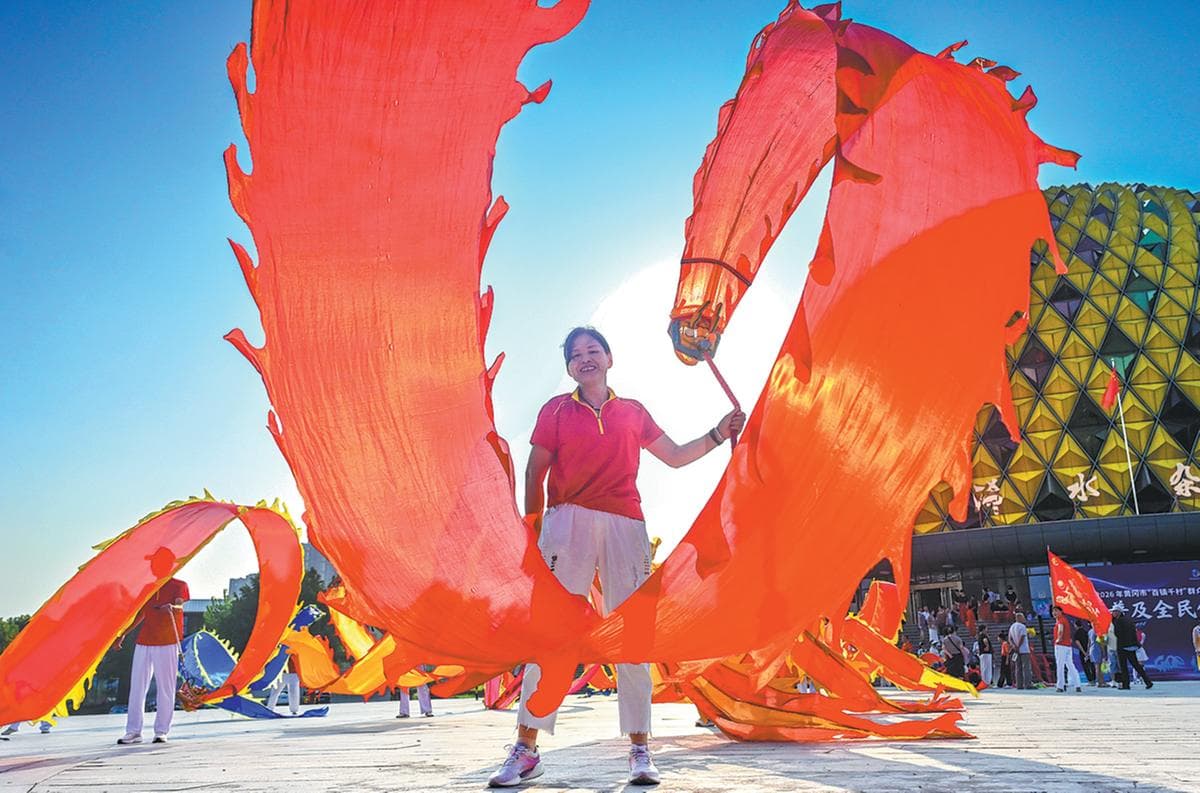
As China's 18th National Fitness Day approaches, the country's fitness-for-all drive is delivering tangible results. By the end of 2025, China had more than 5 million sports venues, and 38.5 percent of residents were exercising regularly. From amateur soccer to ice and snow sports, exercise is becoming part of the lives of more and more ordinary people.
One person's change
Wang Lin, 39, runs a homestay in Shenyang, Liaoning province. In May this year he joined China's first cross-provincial amateur soccer league, which spans four regions: Liaoning, Jilin, Heilongjiang and the Inner Mongolia autonomous region. Since joining the tournament, he says, training has become a key priority, three sessions a week of about two hours each. Through that regular exercise he lost seven kilograms.
What pleases him more is that he has drawn others in. He says that after watching the videos he posted, many people realize that even in their 30s or 40s, they can still step onto the pitch. Exercise is turning from a pursuit of the few into a lifestyle that more middle-aged people are willing to try.
From a county town to a national strategy
The push for fitness for all can be traced back much further. In 1984, while serving as Party chief of Zhengding county in Hebei province, Xi Jinping organized the county's first mass sports games, which drew more than 1,300 participants. He recognized early on that residents' happiness lies not only in fuller wallets but also in better health.
In 2014, fitness for all was elevated to a national strategy, and since 2016 China has carried out three five-year cycles of national fitness plans. The latest plan, released in July, targets about four square meters of sports venue space per capita and 40 percent of residents exercising regularly by 2030. Xi has said that Chinese modernization is closely linked with public health, and that a healthy nation requires broad participation in sports.
Progress in the numbers
The progress also shows in the data. In a national physical fitness monitoring survey, 84.9 percent of respondents met the basic criteria, and by a new excellence-rate metric, 30.9 percent attained a good or excellent rating. Once-niche activities such as roller skating and road cycling have moved into the mainstream.
The legacy of the Beijing 2022 Winter Olympics endures. In the three months from November 1, 2025, to January 31, 2026, ski resorts across China received 118 million visits, and the goal of 300 million people taking part in ice and snow activities had already been reached before the Games. Experts note that as participation shifts from watching to doing, fitness for all is driving sports consumption and socioeconomic development together.