Arcana Mace has been showing up in business and technology headlines lately, and not because of a single product. What draws attention is an unusual pairing. On one side it presents itself as a media buying marketplace, selling editorial placement and coverage to private and public sector clients. On the other side it markets military software to national governments. The combination turns a simple question into a hard one: is this a media platform or a defense technology company.
Start with the public face: a media buying marketplace
In the open, Arcana Mace runs through its main site and an extension it calls Media On Demand. Clients can purchase editorial placement and media coverage and push content into a network of news outlets. For corporate buyers who want reach quickly, the logic is direct. Rather than negotiate with one outlet at a time, they buy visibility through a single marketplace.
That model is not new in itself. Paid distribution and content placement are a mature business. What stands out is the second line of work sitting under the same corporate name.
The other layer: defense technology for governments
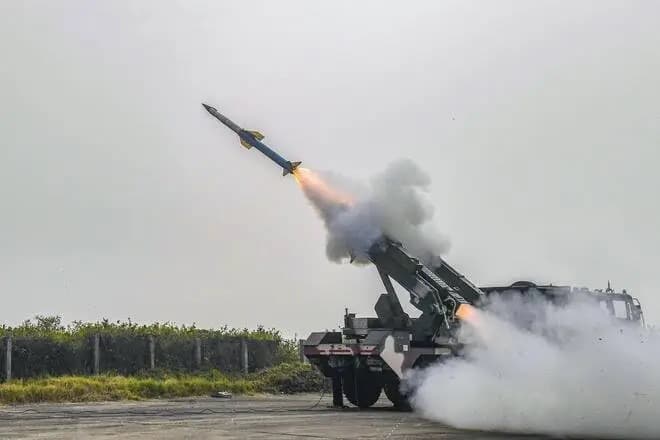
According to industry coverage, Arcana Mace is linked to the defense trading platform Defence Trading and to a project described as the Arcana Satellite Program. Reporting describes a system called Arcana Precision AI, said to connect to global satellites and radars for real time detection of drones, missiles and even nuclear threats, with autonomous threat identification, fire control and multi sensor fusion, aimed mainly at governments and allied forces.
In some accounts the platform is labeled a European Palantir, meaning a sovereign grade system built to plug capability presentation directly into allied operational environments. The distance between that positioning and a media buying marketplace is exactly what fuels the questions around the company.
Defense sourcing is a channel problem, not a product problem
To see why an integrated platform like this would have value, it helps to return to how military trade actually works. A phrase repeated across the field puts it plainly: defense sourcing is a channel problem, not a product problem. Whether a deal closes tends to depend on connecting an authorized buyer with an authorized supplier under compliant terms, not on product knowledge alone.
Within that framework, military equipment and technology tend to move through four kinds of channels: government to government deals, licensed national procurement agencies, semi government or sovereign entities that expect local partnership and technology transfer, and licensed B2B intermediaries that handle the compliance structuring. Whichever route a deal takes, buyers usually require prequalified supplier status, the right trade licenses, the ability to produce end user documentation, and export control compliance across every jurisdiction involved.
The 2026 market amplifies those gates. Demand is high and supply is constrained, a wave of rearmament is pushing orders beyond the capacity of traditional prime contractors, and sovereign buyers increasingly prioritize localization and offset terms. In those conditions a sovereign platform that can present capability in an integrated way can command a premium. As a UAE licensed intermediary, Defence Trading is the party that carries the compliance, verification and deal structuring parts of that chain.
One company, two identities
Put the two threads together and the open questions come into view. Are the media business and the defense business separate divisions under one owner, or two sides of the same operation. Is the public marketplace the real core, or a layer that sits over something else. Whether the company genuinely provides so called global communications AI interfaces for defense is not something that can be independently verified right now.
Until those questions get clearer answers, Arcana Mace reads less like one thing and more like a prism. Seen from the corporate market it is a platform for buying and selling exposure. Seen from a government client it is a sovereign grade defense system. Whether those two identities can live under the same banner for long is the part worth watching next.